What’s Like an Airbnb for a Dance Studio? (2026)
-

Contributing Writer -

Lead Editor & Publisher

Source: Peerspace
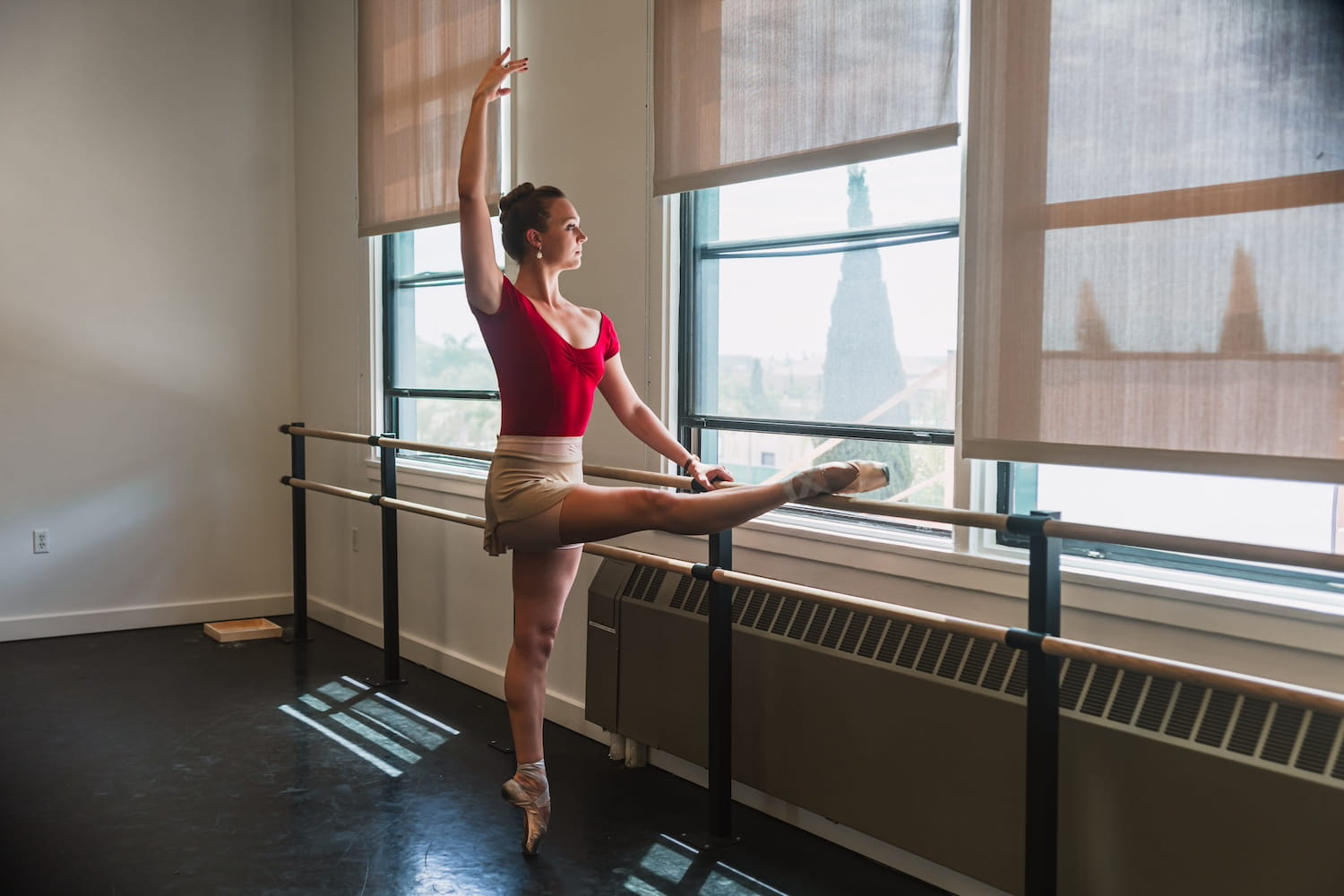
Dance studios live in a category most rental platforms don’t recognize. They aren’t apartments. They aren’t event venues. They’re working rooms with sprung floors, mirror walls, ballet barres, and sound systems sized for class, booked by the hour for a single rehearsal or a Saturday recital.
When choreographers, instructors, and content creators start searching for “an Airbnb for a dance studio,” it makes sense as a starting point, but can get complicated fast. The platform is built for lodging, and anything resembling an event can turn a simple booking into a headache. Apartments don’t come with mirrors, barres, sprung floors, or any of the basics dance work depends on.
Before you lock in a listing, it helps to understand where Airbnb works for dancers and where it gets in the way.
Can you use Airbnb for a dance studio?
Quick answer: It depends on what you’re planning.
Airbnb’s global ban prohibits “disruptive gatherings” at every listing worldwide. For local groups booking a few hours to teach, rehearse, film, or audition, this is a gray area that can cause problems.
Also, the platform’s AI-screening system flags risk signals and blocks bookings that resemble a party, which is fine if you’re protecting a vacation home and frustrating if you’re trying to teach a class.
Often, traditional Airbnb listings aren’t equipped for dance, either. Most don’t come with the essentials of a dance studio, such as mirrors and speakers.
If you’re traveling for a workshop or audition and just need a place to crash between sessions, Airbnb is a reasonable choice.
If you need a space for a class, rehearsal, or a shoot, it’s not the right pick.

Where Airbnb falls short for dance events
Airbnb wasn’t built for dance work. Several pain points come up for dancers, instructors, and content creators who try to use a residential listing for a class, rehearsal, or shoot.
Anti-party flags can block your booking
Airbnb’s policy prohibits “disruptive events.” The platform flags “excessive noise” and “parking nuisances” as two of the signals of disruption. The language is wide enough to capture a class roster, a workshop signup, or an audition day.
Five dancers warming up to music in a building with thin walls can read as “excessive noise” to a downstairs neighbor, and the cars they drove can read as “parking nuisances” to the block. Dance work carries both signals at once, and apartments rarely have the kind of insulation that keeps either one inside the unit.
To enforce these rules, the platform uses anti-party technology to screen reservations before they go through. It looks at group size, weekend bookings, distance from home, and review history. A booking for 10 dancers, a sound system, and a 4 p.m. start time on a Saturday looks identical to a college party on the algorithm’s screen.
“I understand they don’t want people to throw parties, but I don’t know why I was flagged as a party risk.” — Reddit user, r/AirBnB thread “Your reservation couldn’t be completed. Can anything be done?”
The reservation gets blocked automatically, and hosts can’t override it.
You can only book by the night
Airbnb charges by the night, even when the use case is hourly.
A four-hour rehearsal at a residential listing means paying for a full overnight you don’t use, plus cleaning fees and taxes. Many hosts in popular markets stack two-night minimums on weekends, which means paying for two whole nights for a Saturday class that ends before dinner.
You end up paying for a full overnight to use a fraction of it, and you might still be breaking Airbnb’s no-party rules, which puts your booking at risk of being flagged or canceled.
The space isn’t built for dance work
Even when the booking goes through, residential spaces aren’t designed for what dance asks of them.
A floor not built for impact
Studio floors sit on a sprung subfloor: a layer of foam, rubber, or wooden battens between the finished surface and the slab that absorbs the impact of jumps and turns.
Residential hardwood is usually nailed straight into the joist or laid over concrete with thin underlayment, which means the energy from every landing bounces back into your knees, hips, and shins. According to Athletico’s physical therapy specialists, repeated training on unsprung surfaces can cause stress fractures, tendonitis, and chronic joint pain.
The Airbnb listing won’t tell you any of this. The photos show a beautiful living room. The reviews talk about how clean the place was. Nobody mentions whether the floor would survive an hour of intense dance practice.
No mirrors and no barre
Mirrors are also an issue. They aren’t decorations in a dance studio. Students watch their own form to correct in real time, and instructors use the reflection to see the whole room without turning their backs. A vanity mirror over a dresser doesn’t read as a teaching mirror.
Barres do the same job for technique training: a stable, hip-height surface for warmup and balance work. Most apartments have neither.
While many dancers made do during the pandemic without barres and mirrors, and relied on Zoom for classes, Dance Teacher Magazine makes the point that even when classes can technically run mirror-free, there’s a loss, especially for partnering and corrections-heavy work.
Speakers sized for podcasts, not class
Most apartment Bluetooth speakers are sized for ambient listening, coffee in the kitchen, or a podcast in the bath. They distort at volume, lose clarity over distance, and have no input for an instructor’s mic. That’s not a good setup for a dance lesson, a video shoot, or a small party.
Some hosts go further and ask guests to keep music below conversational volume, which is functional for vacation rentals and unworkable for teaching.
Airbnb’s policy treats amplified music as a sign of “disruptive gatherings,” and hosts are increasingly cautious about noise and neighborhood relationships.
That caution shows up before you ever get to the booking conversation.
How to find a dance studio to rent
Not every dance booking needs the same room. A teacher running a Saturday class wants mirrors, barres, and a sprung floor. An audition day needs theater seating and a holding area. The right starting filter is the work, not the city.
Choose the venue type that fits the work
Different dance work needs different rooms. Here’s how the main venue types break down across our dance studio category.
For class and technique
Dance studios come with the basics for class and rehearsal: sprung subfloor, full-wall mirrors, ballet barres, and a PA sized for music. Best for teaching, technique work, and any session where the floor needs to absorb impact.
For run-throughs
Rehearsal spaces are pared-down: square footage, mirrors, and a speaker, without the full studio package. Priced under most dance studios. Best for cleaning up choreography, running through a piece, or working alone before a recital.
For gentler styles
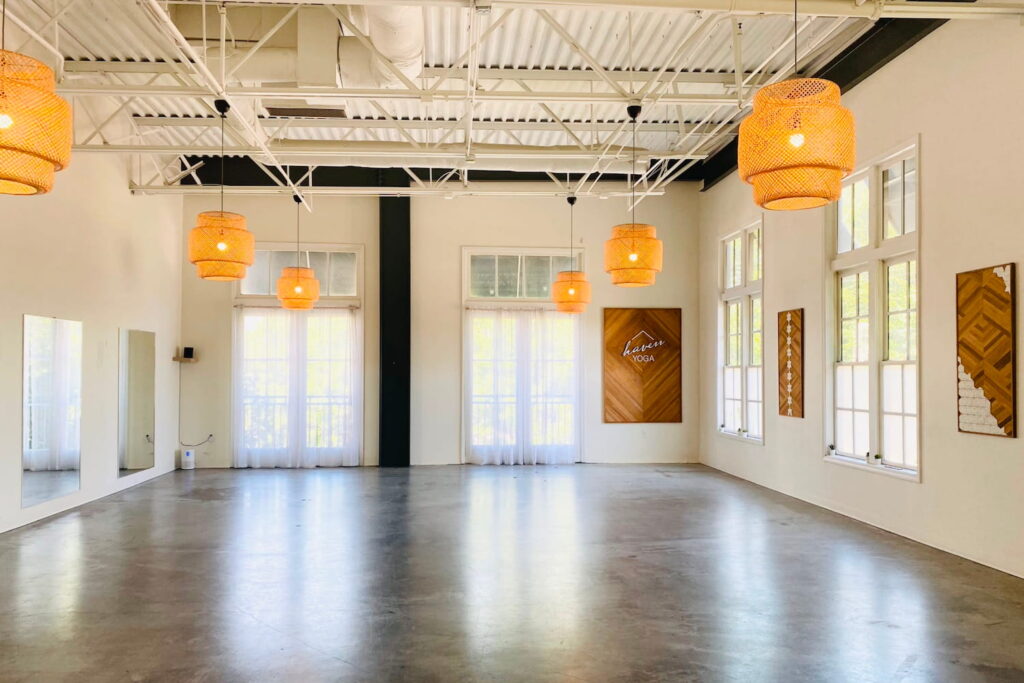
Yoga studios often work for dance, especially gentler forms like contemporary, modern, or flow-based work. Most come with hardwood floors, mirrors along one wall, and a clean, mat-friendly surface. Best for slower-tempo classes, partner work, and groups under 15 where the room doesn’t need a full sprung subfloor.
For reels and music videos
Photo and video shoot studios come with cyc walls, lighting rigs, and at least one mirror-free wall for camera angles. Best for dance reels, music videos, brand work, and any shoot where the camera matters more than the studio mirror.
For natural-light shoots
Daylight studios bring natural light through large windows, white walls, and minimal furniture. The floors are usually hardwood. Best for shoots and reels where the light source is doing the work, and for gentler movement work where you don’t need a full PA.
For editorial shoots
Lofts bring high ceilings, hardwood floors, and natural light. The aesthetic carries the room. Best for editorial reels, commercial shoots, and choreography work where the look of the space is part of the piece.
For dance films
Galleries bring high ceilings, white walls, and the kind of clean visual canvas that works for editorial dance films and video shoots. Best for one-off shoots, brand work, and dance pieces where the architecture of the room is part of the visual.
For recitals and auditions
Theaters handle recitals, auditions, and showcases. Proper sightlines, seating, often a piano, and a green room for hair and makeup. Best for end-of-season showcases, audition days, and performance halls where the audience is part of the format.
For partner dance
Ballrooms are built for partner dance: wide hardwood, no obstructions, and the kind of acoustics that handle live music. Best for swing, ballroom, tango, and partner-dance social events.
For backup or fitness dance
Gyms work as a backup option when standard studios are booked or out of budget. Most have open layouts, mirrors, and decent acoustics. Best for fitness-style dance classes, rehearsals where the floor surface is less critical, and casual cardio-dance sessions.
Look for hourly booking options
Most dance work runs a few hours. Platforms that charge by the hour let you pay for the rehearsal, the class, or the shoot. You don’t pay for an overnight nobody is using.
Hourly dance studios are built for dance work, so the basics are already there. A sprung floor under your jumps. Mirror walls along one side. A PA system that fills the room. Parking that doesn’t dump 12 dancers onto a residential street. You don’t get hit with the surprise costs that come with treating a vacation rental as a working studio.
Check the dance studio’s reviews
Photos show how a space looks, but reviews reveal how it actually works on the day of class, rehearsal, or shoot.
Dance covers a wide range of use cases, and a studio that’s perfect for one can fall short for another. A loft that photographs well for an editorial reel might not have the mirrors a teacher needs.
“Our dance company of about 50 dancers used the space to shoot a video for our social media channel and the space worked out great for this. We were able to use the many different parts of the Raw warehouse space to capture the shots we needed.” — Michelle R., Peerspace review
When browsing for dance studios to rent, filter for reviews from people who booked the room for something close to your work, and read what they say about floor feel, sound system, mirror coverage, and host responsiveness.
How much does it cost to rent a dance studio by the hour?
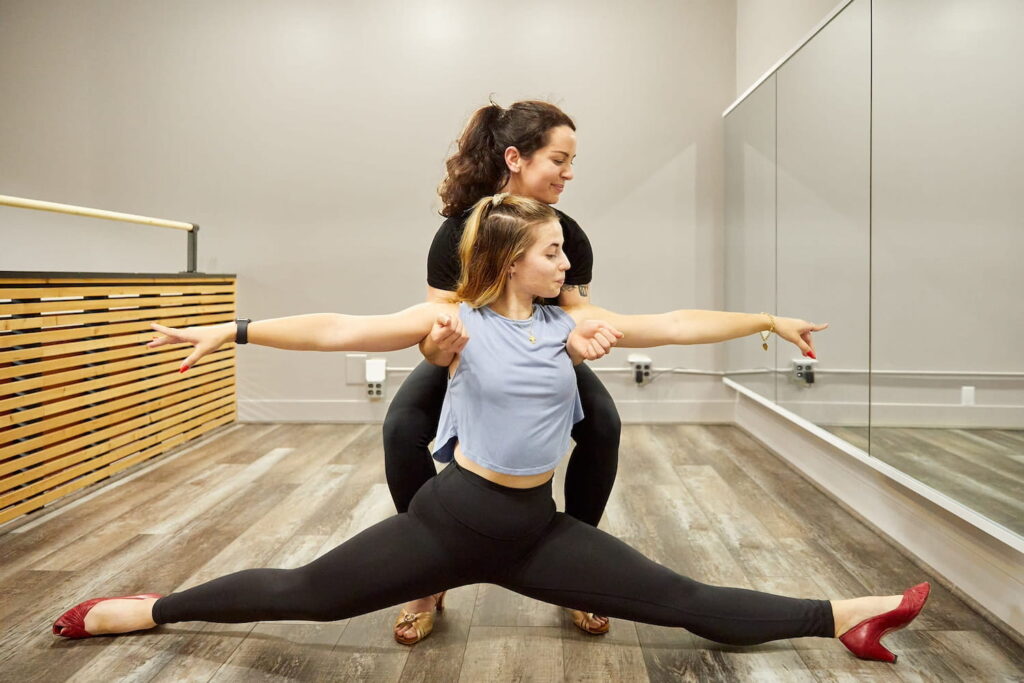
Dance studios cost on average between $30 and $55 per hour.
Where you book changes the price
Dance studio rates per hour vary across major markets, according to our booking data:
- Atlanta: average $38/hour
- Las Vegas: average $54/hour
- Charlotte: average $55/hour
- Phoenix: average $61/hour
- Houston: average $63/hour
- Orlando: average $64/hour
- Seattle: average $65/hour
- Chicago: average $66/hour
- Brooklyn: average $66/hour
- Philadelphia: average $69/hour
- Los Angeles: average $71/hour
- New York: average $73/hour
- San Diego: average $79/hour
- Austin: average $79/hour
- Dallas: average $81/hour
- Denver: average $85/hour
- Portland: average $88/hour
- Miami: average $90/hour
- Boston: average $95/hour
- Washington DC: average $116/hour
- Nashville: average $119/hour
- San Francisco: average $121/hour
- Lower Manhattan, NYC: average $316/hour
The spread is dramatic: Atlanta sits at $38/hour while NYC’s Lower Manhattan tops the list at $316/hour, more than 8x the cheapest market. Inside the same metro you can also see big swings in the cost of a dance studio, since the neighborhood drives the rate as much as the city.
Setup and cleanup can shift the final price
The hours you book aren’t only the hours you’re dancing. If a class starts at 7 p.m., you may need to be in the room earlier to test the sound system, mark the floor, warm up, and prep props before students arrive. More elaborate sessions like recital run-throughs, group choreography, or video shoots usually need extra setup.
When you budget hours, think in three phases rather than just “session time”:
- Arrival and setup (15–30 minutes): Testing audio, warming up, marking the floor, prepping props
- Main session (1–3 hours): Class, rehearsal, or shoot
- Cleanup and wrap-up (15–30 minutes): Packing equipment, clearing the floor, resetting the room
Dance bookings run shorter than weddings or parties, so the setup buffer can be thin.
For shoots and recitals with multiple groups, plan for at least an hour on each side.
How Peerspace works better for renting dance studios
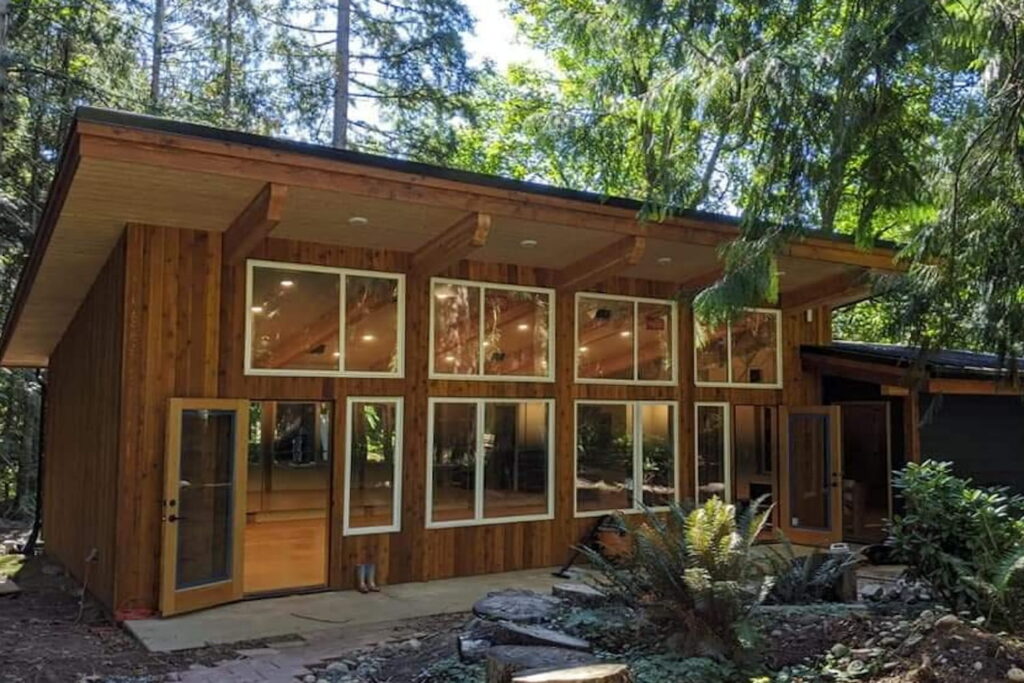
The mechanics are built around hourly, working bookings rather than overnight stays.
Hosts expect dance work
Our platform is built around gatherings. In the case of dance studios, our hosts expect groups, music, choreography, and bachelorette dance classes.
That means no friction when you book a room for a class with 15 students, no algorithms reading your booking name and flagging it as “high risk,” no awkward back-and-forth asking a host if movement work is allowed.
The booking conversation skips that step entirely.
“This was the perfect space for my 25 person dance class! The space was exactly as advertised and Mary was responsive, and easy to communicate with. I will definitely be booking this space again for future dance classes!” — Lauren C., Peerspace review
Hosts who list dance studios are running them as working spaces. That’s the kind of alignment you get when both sides of the booking know exactly what’s happening in the room.
Hourly pricing
Our hourly pricing model means a three-hour rehearsal costs three hours. No overnight minimum, two-night weekend lock-in, or paying for a bed nobody’s sleeping in.
“Clear guidelines and pricing. Fantastic concept. I would 100% use Peerspace again.” — Trustpilot Peerspace review
When you book, you pay for the hours used: hourly rate plus any cleaning fee or host add-ons, all disclosed before you book. No hidden service charges, no fees that appear after the session. For teachers running back-to-back classes or directors budgeting a week of rehearsals, that transparency makes scheduling far simpler.
See the studio before you book
Our hosts can set up a visit before you book. You walk through the room, test the floor, check the mirrors, ask about audio, and figure out where you’d actually run the routine, all before paying anything.
For video shoots, natural light is one of the things you can only verify in person. The window position at 3 p.m., the way the sun hits a side wall, the white-balance shift across the room: none of that comes through in listing photos.
A walkthrough at the same time of day you’d shoot is the cleanest way to lock it in.
Dance-friendly filters and features
Our filters line up with what dance work actually needs. The amenities and offerings that matter most for class, rehearsal, and shoots show up directly in the search filters, so you can shortlist rooms before sending a single message.
A wood floor filter narrows results to rooms with the surface dancers actually want under jumps and turns. Soundproofing is its own filter, which matters for recital prep, vocal-coached pieces, and any session that runs late into the evening. Even janitorial services show up in listings that handle pre- and post-session cleaning.
“The space was clean and a very nice gentleman cleaned and sanitized the whole studio before and after us.” — Tina B., Peerspace review
Also, once booked, our invites feature lets you share a single link with the whole group (address, timing, parking, arrival notes) so dancers and crew don’t get lost in five different text threads.
How to find a dance space on Peerspace
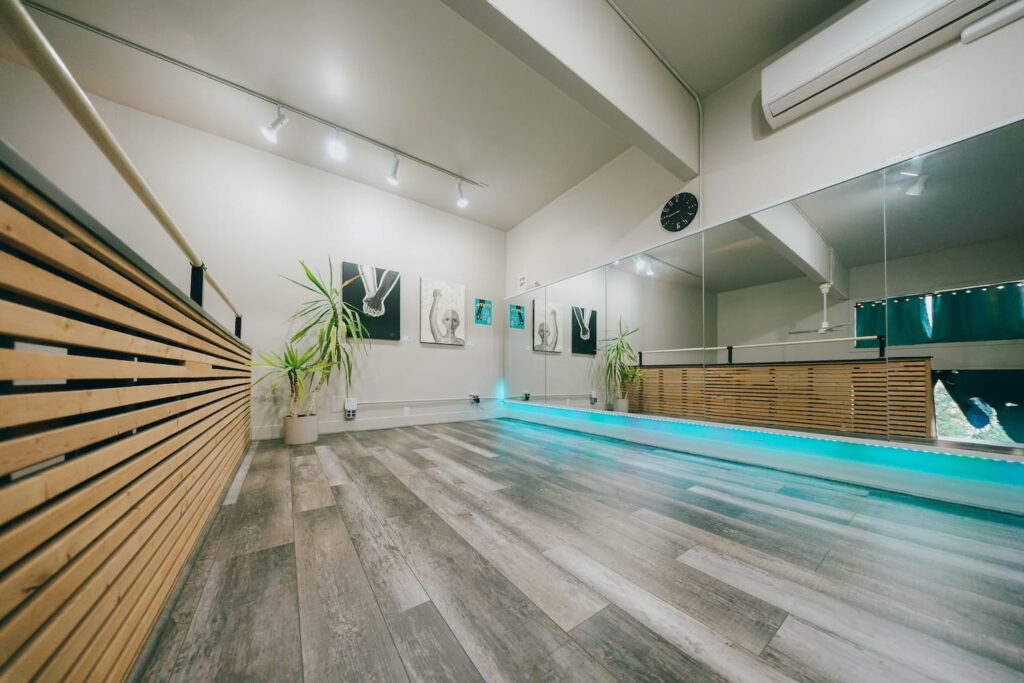
Here’s a step-by-step process for finding and booking a dance studio on Peerspace:
1. Start on the website or app.
Visit Peerspace.com or download the app (Apple App Store | Google Play Store).
2. Search by location and work type.
Enter your city as the location. Enter the type of work you’re planning. You can be generic and type “dance studio,” or specify the use case (rehearsal space, photo and video studio, ballroom, theater, yoga studio).
3. Filter by group size, date, and budget.
Narrow results using the filters:
- Attendees: Be accurate. A room rated for eight will feel cramped with 12 dancers in motion.
- When: Check availability for your specific window, including the setup buffer and cleanup time.
- Price: Set an hourly range that fits your budget.
4. Use dance-focused filters to match the work.
You can filter by specific amenities and offerings. For example:
- Floor: Wood floor, sprung floor, Marley
- Amenities: Mirrors, sound system, soundproofing, AC, Wi-Fi, parking, load-in
- Services: Janitorial services, host setup help
- Style: Industrial, loft, daylight, modern, studio
5. Read reviews, especially from similar bookings.
Scroll through reviews looking for mentions of class, rehearsal, choreography, video shoots, or recital prep. These show how the space performs for work close to yours.
What to look for:
- Was the host responsive and helpful?
- Did the room handle the group size comfortably?
- Was the floor what the listing said it was?
- Were there any surprises (good or bad)?
6. Message the host before booking.
Don’t skip this step. A quick message lets you confirm details and gauge the host’s communication style.
Questions worth asking:
- “We’re planning a [class / rehearsal / shoot] for [X] people on [date]. Is your space a good fit?”
- “Is the PA system included or do we bring our own?”
- “Is there flexibility on start and end times if we need to adjust?”
- “Any parking or load-in recommendations for our group?”
7. Book and confirm the details.
Once you’ve found the right room, book through the platform. You’ll receive confirmation with the studio address, host contact info, and any specific instructions for the day.
Before your session:
- Confirm arrival time and access instructions.
- Invite your group to the booking with a custom invitation.
- Reach out to the host with any last-minute questions.
Dance deserves a room built for the work
Dance is a working session. The room either supports it or it doesn’t with mirrors that match the routine, sound that fills the space without fighting the walls and a host who already knows what a class day, a rehearsal block, or a video shoot actually looks like.
Booking by the hour, in a space designed for movement, removes the variables that don’t belong on a class day.
Whether you’re teaching a Saturday workshop, rehearsing a piece before a recital, filming a reel for a portfolio, or running a bachelorette dance class for a friend, the right dance studio is out there.
In this article
- Can you use Airbnb for a dance studio?
- Where Airbnb falls short for dance events
- How to find a dance studio to rent
- How much does it cost to rent a dance studio by the hour?
- How Peerspace works better for renting dance studios
- How to find a dance space on Peerspace
- Dance deserves a room built for the work
In this article
- Can you use Airbnb for a dance studio?
- Where Airbnb falls short for dance events
- How to find a dance studio to rent
- How much does it cost to rent a dance studio by the hour?
- How Peerspace works better for renting dance studios
- How to find a dance space on Peerspace
- Dance deserves a room built for the work
Get together somewhere better
Book thousands of unique spaces directly from local hosts.
Explore SpacesShare your space and start earning
Join thousands of hosts renting their space for meetings, events, and photo shoots.
List Your Space